After a veterans roundtable in Brighton on May 6, Rep. Gabe Evans (R-Colo.) made Coloradans a promise about the war with Iran he’d just defended.
Evans represents Colorado’s 8th Congressional District, a critical swing district encompassing suburban Denver, Greeley, and major agricultural stretches of Weld and Adams counties.
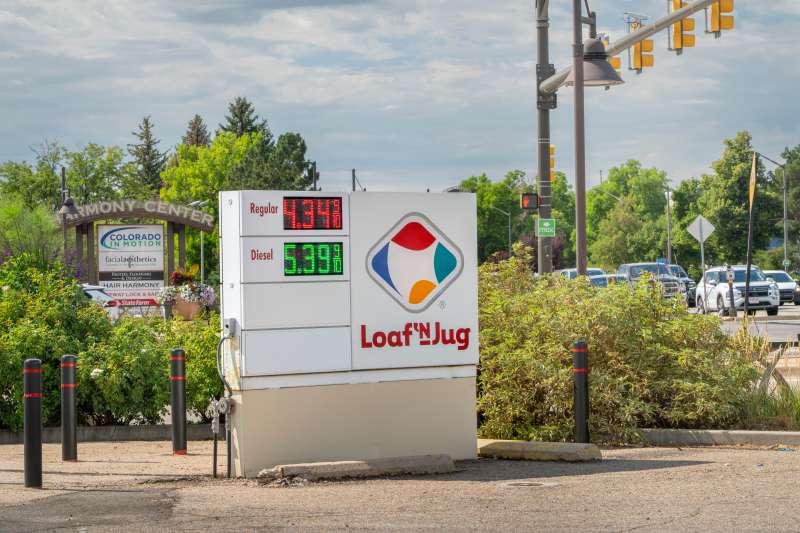
“It’s going to get wrapped up, gas prices are going to go down,” he told CPR News on May 6. That day, Colorado drivers were paying about $4.41 a gallon.
Nearly five months later, the war isn’t over. Colorado’s average price for regular gas is $4.31, barely a dime lower.
Evans has backed President Donald Trump’s decision to attack Iran, and he’s voted against every House effort to end the war. The costs keep showing up here: at the pump, on farms, and in school budgets.
How much more are Coloradans paying since the war began?
In the last full week before US and Israeli strikes began on Feb. 28, regular gas in Colorado averaged $2.58 a gallon, according to the US Energy Information Administration. Last week, it averaged $4.26. That’s about 65% higher, or roughly $25 more to fill a 15-gallon tank.
In the Greeley area, a gallon averages $4.15, up from $2.99 a year ago.
Diesel has been hit harder. Colorado’s average hit an all-time record of $6.22 on Sept. 22, and it sits at $6.19 this week, up from $3.54 a year ago.
For Evans’ constituents in Weld County—one of the top agricultural-producing counties in the country—the surging fuel costs land right in the middle of fall harvest.
Diesel runs the tractors, combines, and trucks that move crops, and the spike is landing during harvest. Nationally, farm diesel averaged $5.45 a gallon in early September, up about 80% from a year earlier, according to the American Farm Bureau Federation.
It’s also riding on school buses. The Greeley-Evans School District says its finance team is watching fuel costs closely. “It really just depends on how long these prices stay elevated,” a district spokesperson told CPR News. Denver Public Schools warned it could spend more than $100,000 above its transportation budget.
Those costs ripple through everything else. Inflation in the Denver metro, which includes Adams and Broomfield counties, climbed from 2.6% in January to 5% in May, before easing to 3.9% in July. Energy prices are up 17.2% over the year.
Why haven’t prices come down?
The war is the main reason. AAA’s Colorado spokesperson told CPR News that most of the pressure comes from the prolonged closure of the Strait of Hormuz, with limited refining capacity also playing a role.
Trump doesn’t expect relief soon. “Right after the election, oil prices are going to be tumbling downward,” the president told reporters on Sept. 9.
Evans, meanwhile, has increasingly blamed state regulations and Democratic lawmakers for high fuel costs. But Colorado’s average gas price sits below the national average of $4.48.
How has Evans voted on ending the war?
Since March, the House has voted five times on resolutions directing Trump to pull US forces out of the war. Evans voted no every time.
One of those votes—a May 14 War Powers resolution directing the removal of US forces—failed on a 212-212 tie. A single “no” vote switching sides would have passed it. The House passed the three most recent resolutions, but they’re nonbinding, meaning they’re essentially expressions of support or disapproval on the president’s actions from members of Congress.
The war has cost the Pentagon about $38 billion through Aug. 1, according to the Congressional Budget Office, and could add $2 billion to $3 billion each month it continues.
It has also cost lives. Eighteen US service members have died. One of them, Sgt. Benjamin Pennington, 26, was stationed at Fort Carson, just outside of Colorado Springs, with the 1st Space Battalion. He was wounded in a March 1 attack in Saudi Arabia and died a week later.
Evans promised in May that the war would “get wrapped up.” Coloradans are still waiting, and still paying.