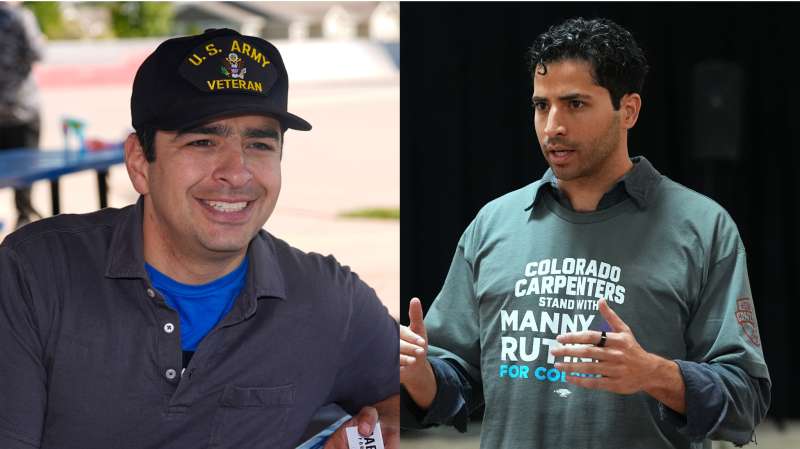
The Oct. 7 debate in Berthoud was the only scheduled face-to-face showdown between Evans and Democratic challenger Manny Rutinel in Colorado’s 8th District ahead of the Nov. 3 election. Beyond arguments over healthcare, the economy, and President Donald Trump, immigration enforcement emerged as another point of contention.
And in Colorado’s 8th Congressional District, where nearly 40% of residents identify as Latino, questions about Immigration and Customs Enforcement (ICE) carry particular significance.
The district stretches from Denver’s northern suburbs into Weld and Larimer counties, encompassing communities like Thornton, Commerce City, and Greeley. Evans won the seat in 2024 by just 2,449 votes.
Now, with control of the US House at stake, the candidates are offering different approaches to federal immigration enforcement and accountability.
The heightened focus on Colorado’s 8th District has turned the seat into one of the state’s most fiercely contested battlegrounds. Outside political action committees and national groups have poured tens of millions of dollars into advertising across Denver’s northern suburbs, underscoring how closely party leaders view the razor-thin margin Evans won by two years prior.
What did Colorado’s 8th District candidates say about ICE?
Evans opened the debate by framing the election as “common sense versus crazy.”
Rutinel, a former state legislator whose mother immigrated from the Dominican Republic, criticized the Trump administration’s enforcement tactics.
“They’re using masked ICE agents without judicial warrants to separate families,” Rutinel said.
The Democrat supports requiring ICE agents to wear body cameras, use judicial warrants, and face consequences for unlawful conduct.
He also supports comprehensive immigration reform and a pathway to citizenship for Dreamers and longtime undocumented residents.
Evans, a former police officer and Army veteran, emphasized public safety and border security, arguing that immigration enforcement should focus on people who commit crimes.
“We have to secure the border. We have to get the bad guys out of our community, and we have to work to fix the broken immigration system for the people that are trying to do things right,” Evans said.
Both candidates discussed their families’ immigration histories, with Evans referencing his maternal family’s roots in Mexico.
What does Evans’ voting record show?
Although Evans has expressed concern about ICE entering homes without warrants, his legislative record offers another perspective on his approach to federal enforcement.
In July 2025, Evans voted for Trump’s sweeping tax and spending law, which allocated approximately $75 billion in additional funding to ICE through 2029. As reported by Courier Colorado, the broader funding package dramatically expanded detention capacity and enforcement personnel nationwide.
That included $45 billion for detention capacity, alongside billions more for enforcement personnel, transportation, and deportation operations.
The funding dramatically expanded the resources available to an agency whose enforcement practices are being debated nationwide.
Evans has also co-sponsored the bipartisan Dignity Act, which proposes a pathway to legal status for certain undocumented immigrants. The legislation has not become law.
The distinction between the candidates is not simply whether immigration laws should be enforced. Both support prioritizing people who pose serious public safety threats.
Their disagreement centers on the administration’s broader enforcement agenda, how federal agents should operate, and which legal safeguards Congress should require.
Why does this race matter for Colorado?
Colorado’s 8th District includes agricultural communities, growing suburbs, and many families with immigrant roots.
Congress controls ICE’s funding and has the authority to investigate misconduct and establish new safeguards for federal immigration enforcement. Rutinel has called for greater congressional oversight, including investigations into ICE detention facilities and requirements for agents to wear body cameras and obtain judicial warrants.
With November 3rd approaching, voters will decide whether to return Evans to Washington, where he has supported expanding ICE’s resources, or elect Rutinel, who has pledged to pursue stronger oversight of the agency. In a district decided by fewer than 2,500 votes in 2024, immigration enforcement remains a substantive policy difference between the candidates.