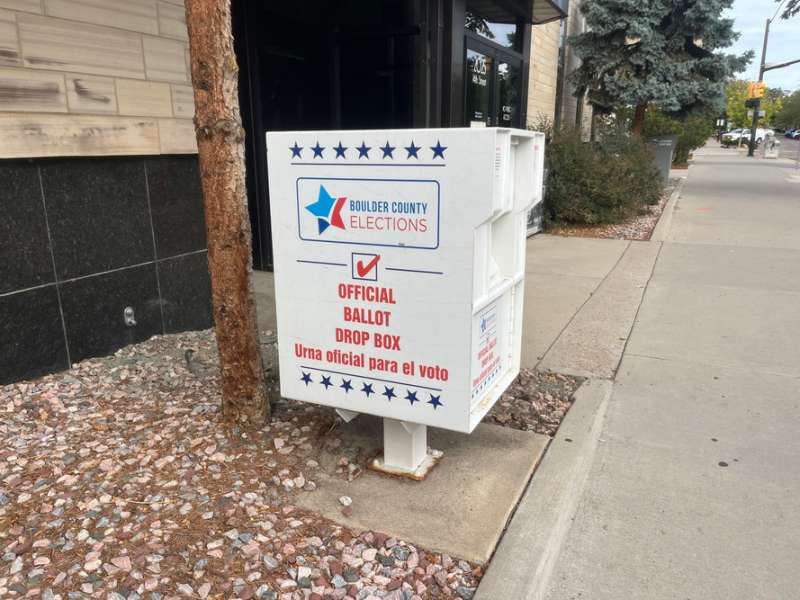
Colorado’s 2026 ballot is headed to mailboxes, and it’s a long one. Secretary of State Jena Griswold certified 14 statewide measures on Sept. 4. That ties a record for the most in at least 52 years, according to Colorado Newsline. Our August guide covered the first seven to qualify, and one of those has since been pulled. This guide covers the eight that came after.
Counties could begin mailing ballots Oct. 2 and must have them all in the mail by Oct. 9. Election Day is Nov. 3.
What’s changed since August
Six measures from our first guide are on the ballot under new numbers:
- Fentanyl penalties (Initiative 85): now Proposition 132
- Notify Homeland Security (Initiative 95): now Amendment 81
- Life sentences for child sex trafficking (Initiative 108): now Proposition 133
- School sports by biological sex (Initiative 109): now Proposition 134
- Ban certain surgeries on minors (Initiative 110): now Proposition 135
- Right to natural gas (Initiative 177): now Amendment 82
Road funding (Initiative 175) is off the ballot. Its backers agreed Aug. 27 to pull it after striking a deal for more road money with Attorney General Phil Weiser, the Democratic nominee for governor, and Democratic lawmakers. They haven’t released the details. State Rep. Andy Boesenecker (D-Fort Collins) said lawmakers plan to send voters their own road-funding question in November 2027.
Measures marked “Amendment” change the state constitution and usually need 55% of the vote. “Propositions” change state law and need a simple majority.
Which measures on Colorado’s 2026 ballot deal with taxes?
Three of these eight measures — Amendment 87, Proposition NN and Proposition 137, covered further down — involve TABOR, the Taxpayer’s Bill of Rights. It’s a 1992 constitutional amendment that caps how much tax revenue the state can keep each year and refunds the rest.
Amendment 87: Graduated income tax
Constitutional amendment; simple majority.
This measure would replace Colorado’s flat 4.4% income tax with six brackets starting in 2027. The rate would drop to 3.7% on the first $25,000 of taxable income and to 4.2% up to $100,000. It would stay at 4.4% up to $500,000, then rise to as high as 8.4% on income over $1 million.
The state’s official voter guide, called the Blue Book and written by nonpartisan Legislative Council Staff, estimates that people with taxable income under about $510,000 would pay up to $325 less a year, and people above that would pay more. The measure would raise about $2 billion in its first full year for K-12 schools, health care and early childhood programs. That money would be exempt from TABOR’s cap. The ballot question itself lists $2.7 billion, the high-end estimate state law requires to account for forecasting error.
It needs just a simple majority because its constitutional change only repeals the flat-tax requirement.
The Protect Colorado’s Future coalition, led by the Bell Policy Center and the Colorado Fiscal Institute, backs it. Opponents, including the Colorado Chamber of Commerce, say higher rates would push businesses and high earners out of state. Advance Colorado, a conservative nonprofit that doesn’t disclose its donors, also opposes it. The group is behind six of the 14 measures on this year’s ballot.
A lawsuit filed Sept. 16 in Denver District Court argues that nearly 10,000 petition signatures should be thrown out, which would leave the measure short of qualifying. As of Oct. 5, no ruling had been reported.
Proposition 136: Income tax cap
Statue; simple majority.
This measure would make 4.4% the maximum income tax rate for individuals and corporations under state law. Nobody’s tax bill would change.
It’s Advance Colorado’s counter to Amendment 87.
If both measures pass, state law says the one with more “yes” votes controls where they conflict. The Blue Book says the exact outcome would be unclear, and that a court or the legislature will need to sort it out.
Proposition NN: More school funding from TABOR refunds
Statue, referred by the legislature; simple majority.
This measure would let the state keep money it would otherwise refund under TABOR, up to a new, higher cap tied to K-12 spending. For 10 years, that money must go to teacher pay, smaller class sizes, career and technical courses and children’s programs. After that, a set amount still goes to those K-12 priorities, and lawmakers decide how to spend the rest.
Nonpartisan staff estimate it would eliminate TABOR refunds for the next two budget years. A single filer earning $50,000 would see a $21 refund in 2027 drop to zero.
Democratic lawmakers sent it to the ballot over Republican opposition. It’s backed by the Colorado Education Association, the state’s largest teachers union. Advance Colorado and other TABOR supporters say it amounts to a permanent cut to refunds.
Which measures change how elections work?
Amendment 84: ID numbers on mail ballots
Constitutional amendment; needs 55%.
Voters would have to write the last four digits of their Social Security number, or their Colorado driver’s license or ID number, on their mail ballot envelope. The number would be required in addition to a signature in federal and statewide elections. Voters with a missing or mismatched number would have eight days after Election Day to fix it. In-person voting rules wouldn’t change.
The change would affect most Colorado voters: 92% of ballots cast in 2024 were mail ballots.
The Colorado Voter Trust Initiative is backing it. The group is led by former Deputy Secretary of State Suzanne Taheri and El Paso County Treasurer Chuck Broerman, a former county clerk. The Coalition for American Prosperity and Growth, an Ohio-based group that doesn’t disclose its donors, had given $2.25 million of the $4.2 million the committee raised through Sept. 21.
Opponents include the League of Women Voters of Colorado and Common Cause Colorado. They say eligible voters’ ballots could be rejected over simple clerical errors.
Amendment 85: Plain-language ballot questions
Constitutional amendment; needs 55%.
This measure would require every state and local ballot question to be written at no higher than an eighth-grade reading level. It doesn’t define plain language or say who decides whether a question meets the standard.
It would also block laws that require citizen initiatives to include wording that conflicts with that standard. One example is current law requiring tax-cut measures to say which state programs could lose money.
It’s backed by Advance Colorado. The League of Women Voters of Colorado opposes it. Plain language is “a worthy goal, but it’s already the law and putting it in the constitution will limit our ability to improve on it later,” executive director Beth Hendrix said, according to CPR News.
Amendment 86: Limits on mid-decade redistricting
Constitutional amendment; needs 55%.
This measure would apply to any congressional map redrawn between the once-a-decade redistricting cycles. Such a map would need approval from both the independent redistricting commission and the Colorado Supreme Court, after at least three public hearings. Maps couldn’t be drawn to favor a political party.
It responds to a Democratic-backed effort to redraw Colorado’s map. That map likely would have given Democrats seven of the state’s eight US House seats, but the state Supreme Court blocked it from the ballot in June. Colorado’s US House delegation is currently split 4-4.
Advance Colorado brought the measure. A leadership PAC created by US House Speaker Mike Johnson (R-Louisiana) gave $250,000 in August to Fair Redistricting Colorado, a committee supporting it. Opponents, including Colorado Draws the Line, a committee tied to Democrats, say it would stop Colorado from responding to partisan redistricting in other states.
Which measures deal with the outdoors?
Amendment 83: Right to hunt and fish
Constitutional amendment; needs 55%.
This measure would add a right to hunt and fish by “traditional methods” to the state constitution. It would also make hunting and fishing the state’s preferred way to manage wildlife populations. Endangered species and species that aren’t normally hunted would be excluded, and the state could still regulate hunting and fishing.
Current rules wouldn’t change right away, but future rules could depend on how courts interpret the new right. Colorado would join 24 other states with similar language.
The International Order of T. Roosevelt, a Wisconsin-based hunting group, has given the campaign $1.15 million, according to state campaign finance records cited by KGNU.
Opponents, including a committee called Protect Colorado’s Constitution, say the measure never defines “traditional methods.” They argue that could invite lawsuits over hunting and trapping practices Colorado has banned.
Proposition 137: Sporting goods tax for conservation
Statute; simple majority.
This measure would let the state keep an amount equal to the sales tax it already collects on sporting goods, about $175 million a year, outside TABOR’s cap. That money would go to wildfire prevention, land and water conservation and outdoor recreation.
There’s no new tax, but it would shrink TABOR refunds in surplus years, by an estimated $26 to $83 for single filers, and leave less for the rest of the budget in other years. It could also shrink what Proposition NN brings in.
The Nature Conservancy, Conservation Colorado and Western Resource Advocates back it, and so does Weiser, who endorsed it in late September. The Colorado Democratic Party and the League of Women Voters of Colorado oppose it. The main opposition committee, Protect Colorado’s Land, Communities, and Tax Dollars, argues the money would pay for “industrial logging.” Supporters say the state needs a reliable funding source for conservation as drought and wildfire damage increase.
Also on some ballots: Voters in the Front Range Passenger Rail District, which covers all or part of 13 counties from Weld to Las Animas, will see Ballot Issue 7A, a proposed 0.333% sales tax for planned passenger rail along the Front Range.
Every voter household also receives the state’s official Blue Book, which includes arguments for and against each measure.
Mailing your ballot back? The secretary of state recommends sending it by Oct. 26. After that, return it to a drop box or voting center. Ballots must be in by 7 p.m. on Election Day, Nov. 3. Find the closest one at GoVoteColorado.gov.