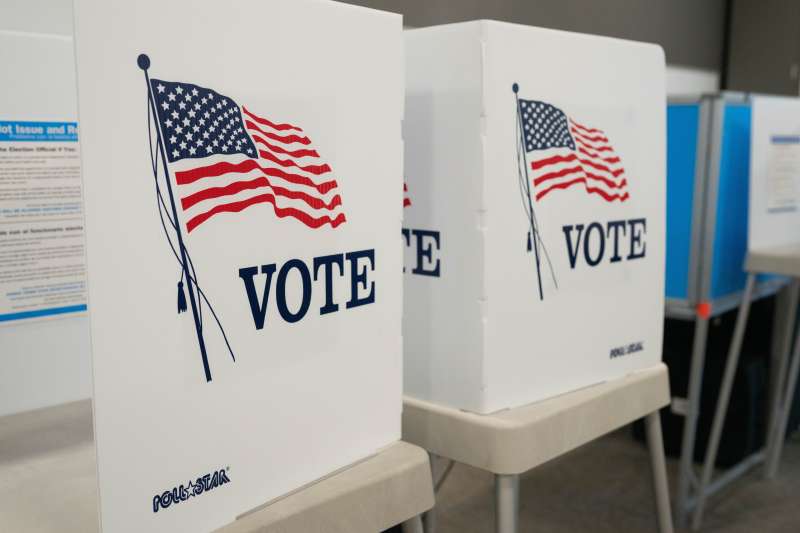
Colorado voters will help decide two separate power struggles this November: whether Republicans keep their razor-thin US House majority, and whether Colorado Democrats can win a legislative supermajority at the state Capitol.
Nationally, Republicans hold the House 218-212, with four vacant seats and one independent who caucuses with the Republicans, meaning Democrats need a net gain of just three seats to take control of the House of Representatives.
At the state level, Colorado Democrats already control the governor’s office, the House and the Senate — a trifecta — and are one seat away from a two-thirds supermajority in each chamber. That threshold that allow lawmakers to override a gubernatorial veto or place proposed constitutional amendments directly on the statewide ballot without Republican support, though any referred amendment would still require 55% voter approval to take effect, according to The Denver Post.
US House
Colorado’s 8th District
In Colorado’s 8th District — the Front Range toss-up district — Republican incumbent Rep. Gabe Evans (R-Fort Lupton) faces Democratic state Rep. Manny Rutinel (D-Commerce City) in a race rated a “toss-up” by nonpartisan forecaster The Cook Political Report — one of the most competitive seats in the country, and a race Democrats need to reclaim their House majority. Read Courier Colorado’s full CO-8 candidate guide for the complete profile.
Colorado’s 3rd District
Western Slope incumbent Republican Rep. Jeff Hurd (R-Grand Junction) faces Democrat Dwayne Romero (D-Snowmass Village) in a district President Trump won by about 10 points in 2024.
Sabato’s Crystal Ball rates the race “Likely Republican” as of mid-August, though a July internal poll commissioned by Romero’s campaign showed the two candidates within a point of each other.
According to the most recent Federal Election Commission quarterly disclosures, which track fundraising through June 30, Hurd has significantly outraised Romero — bringing in roughly $3.52 million and has $1.76 million cash on hand to Romero’s roughly $716,000 raised and $84,000 cash on hand—though a primary challenge from 2020-election-denier Ron Hanks, which Hurd won by a wide margin in June, signaled friction with his party’s far-right flank.
Colorado’s 5th District
This El Paso County seat, long one of the safest Republican districts in the state, was downgraded from “Solid Republican” to “Likely Republican” in January. Republican Rep. Jeff Crank (R-Colorado Springs) won the seat after longtime representative Doug Lamborn retired.
Crank is now facing Democrat Jessica Killin (D-Colorado Springs), and a July poll paid for Killin’s campaign shows the race in a dead heat. Killin, an Army veteran, has outraised Crank with $3.14 million to his $2.17 million.
State Legislature
Colorado Democrats hold a 43-22 majority in the state House and a 23-12 majority in the state Senate — one seat short of a supermajority in each, which requires 44 of 65 House seats or 24 of 35 Senate seats. Republicans are defending after 2024, when recounts in two Colorado Springs-area and Front Range races broke the Democrats’ prior House supermajority.
House District 16 (Colorado Springs)
Republican state Rep. Rebecca Keltie (R-Colorado Springs) isn’t seeking re-election in the seat she won from Democrat Stephanie Vigil (D-Colorado Springs) by just three votes in 2024 after a recount — one of the closest legislative races in state history. Vigil is running again, against Republican Jill Haffley, a retired 30-year Colorado Springs history teacher and current school board vice president, who won a contested GOP primary and was personally endorsed by Keltie as her chosen successor, in a seat both parties see as attainable.
House District 19 (Boulder, Weld, Larimer counties)
Republican state Rep. Dan Woog (R-Add locality), who flipped this seat by roughly 110 votes in 2024 after a recount, faces a rematch with Democrat Jillaire McMillan — a first-time candidate who was named the party’s 2024 nominee by a vacancy committee after then-Rep. Jennifer Parenti dropped her reelection bid, and who is running again after her narrow loss.
Senate District 15 (Larimer County)
A rematch of 2022, when Democratic state Sen. Janice Marchman (D-Loveland) unseated Republican Rob Woodward (R-Loveland) by just over 1,000 votes. Marchman, a former engineer and Thompson School District math teacher, has emphasized wildfire insurance access and public school funding; Woodward, a former small business owner, is campaigning on affordability and repealing “unnecessary regulations.”
Senate District 30 (Highlands Ranch)
Republican state Sen. John Carson (R-Highlands Ranch) holds a seat that Kamala Harris carried by 2.4 points in 2024 – one of the few Colorado legislative districts where the incumbent’s party runs counter to the district’s presidential lean. Democrat Kevin Leung is challenging him, and the party sees it as their best shot at a Senate supermajority.
Ballot measures
Colorado has seven ballot measures confirmed to appear on November’s ballot with more pending certification by state officials. These are covered separately in Courier Colorado’s VoterHub ballot measures guide.
How to vote
Every active registered Colorado voter gets a mail ballot no later than 18 days before Election Day. Register by Oct. 26 to get one mailed; same-day registration is available in person through Nov. 3. Ballots must reach your county clerk by 7 p.m. Nov. 3, regardless of when it was postmarked.